
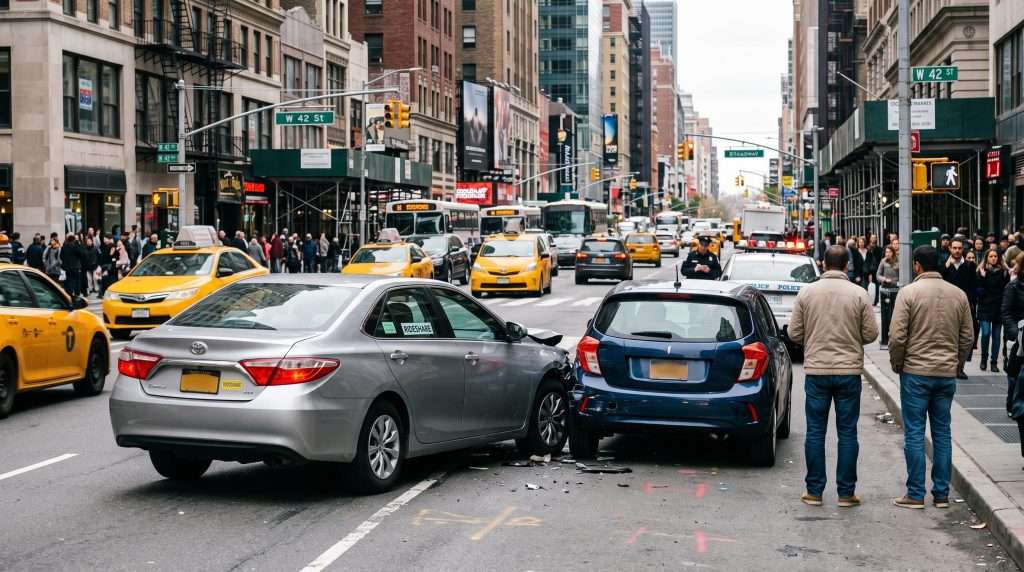
You were in the back seat, you did nothing wrong, and now you’re hurt. Passengers are almost never at fault in a rideshare crash, which removes one problem and creates another: with a driver, a rideshare company, possibly a second vehicle, and several insurance policies involved, it isn’t obvious who is responsible for your medical bills. Here is what to do if you’re injured as a passenger in an Uber or Lyft in New York, and how the coverage rules actually work.
What to Do First
The first hour matters more than most people realize, and the evidence that disappears fastest is the evidence in your own hand.
- Get medical attention, and say clearly that you were a passenger in a rideshare vehicle so it appears in the record from the start.
- Screenshot the trip in the app immediately — driver name, vehicle, license plate, trip route, and time stamps. Completed trips get harder to retrieve later, and app records are the cleanest proof you were in that specific vehicle.
- Photograph both vehicles, the license plates, the TLC or livery plate if you’re in New York City, and the street or intersection.
- Get the driver’s information and the other driver’s information, plus contact details for any witness who stops.
- Report the crash through the app so there is a record with the company, and keep the confirmation.
Which Insurance Applies Depends on Where the Ride Happened
This is the part almost nobody explains correctly, and it is genuinely different depending on which side of the city line you were on.
Outside New York City, rideshare trips fall under the state’s transportation network company rules. Once a driver is engaged in a prearranged trip with a passenger in the car, the TNC insurance requirements call for substantially higher coverage for bodily injury than a personal auto policy carries, along with supplemental uninsured and underinsured coverage and personal injury protection. The required amounts drop when a driver is only logged into the app waiting for a request, which is why the moment of the crash matters. The New York DMV’s information for TNC passengers covers the passenger side of these rules.
Inside New York City, the state TNC framework does not apply. Uber and Lyft vehicles here are licensed for-hire vehicles regulated by the NYC Taxi and Limousine Commission, and they operate under TLC insurance requirements instead, with coverage that must apply around the clock regardless of whether the driver was on a trip. Uber and Lyft operate in the city as high-volume for-hire services.
That rule is the same whether the crash happened on Atlantic Avenue in Brooklyn, Queens Boulevard in Queens, Second Avenue in Manhattan, the Grand Concourse in the Bronx, or Hylan Boulevard on Staten Island — all five boroughs sit under TLC’s framework. What changes the analysis is crossing out of the city entirely. The practical takeaway: the same company, the same app, and the same kind of crash can involve very different coverage depending on whether the trip happened in Brooklyn or in Westchester.
No-Fault Still Covers Your Early Medical Bills
Whichever framework applies, a passenger is a covered person under New York’s no-fault system, so the initial medical bills and a portion of lost wages generally get paid without waiting for anyone to establish fault. The catch is timing: written notice generally has to reach the insurer within 30 days, as the DFS no-fault rules describe. Our explainer on how no-fault works after a New York car accident walks through the coverage limits and what happens when bills exceed them.
Whether you can recover beyond those basics — for pain and suffering — depends on New York’s serious injury threshold, which the Legislature narrowed in 2026. Our article on how insurance adjusters value a New York injury claim explains how that threshold and the fault rules interact.
The Arbitration Wrinkle Passengers Should Know About
If you booked the ride on your own account, you almost certainly accepted the platform’s terms of use at some point, and those terms typically include an arbitration clause. That can route a claim against the rideshare company itself into private arbitration rather than a New York courtroom.
It generally does not affect a claim against the individual drivers, and people who never used the app — a pedestrian, or another vehicle’s occupants — are usually not bound by it at all. We cover this in more detail in our article on rideshare arbitration clauses in New York injury cases.
What Passengers Get Wrong
A few assumptions cause real damage:
- Assuming the driver’s personal auto policy is the relevant coverage. Personal policies commonly exclude commercial passenger use, which is exactly why the TNC and TLC coverage rules exist.
- Losing the trip record by deleting the app, changing phones, or simply waiting too long to pull the receipt.
- Giving a recorded statement to an insurer before anyone has established which policy is even in play.
- Assuming there is no claim because you weren’t driving and don’t own a car. Neither fact prevents a passenger from recovering.
The Deadlines Are Not Generous
Most New York injury lawsuits carry a three-year deadline from the date of the accident, and the no-fault notice window is far shorter than that at 30 days. If a city bus or another municipal vehicle was involved in the collision, a 90-day notice of claim requirement can apply instead — short enough that people routinely miss it before they have finished treatment.
This article is for general informational purposes only and does not constitute legal advice. Speaking with an attorney can help you understand how New York law may apply to your specific situation.
Contact Held & Hines LLP
If you were injured as a passenger in an Uber or Lyft in Brooklyn, Queens, Manhattan, the Bronx, Staten Island, or anywhere else in New York, Held & Hines LLP can review the facts under our Rideshare: Uber and Lyft and Motor Vehicle Accidents practice areas and help you understand your options. Contact the firm for a consultation.
FAQs
Who pays if I’m injured as a passenger in an Uber or Lyft in New York?
It depends on where the trip occurred and the driver’s status at the time. Trips outside New York City fall under the state’s transportation network company rules, which require substantially higher coverage during a prearranged trip. Inside the city, Taxi and Limousine Commission rules apply instead.
Is Uber insurance different in NYC than in the rest of New York State?
Yes. New York City rideshare vehicles are TLC-licensed for-hire vehicles governed by TLC insurance rules, while trips elsewhere in the state fall under the transportation network company framework, which carries higher trip-period requirements.
I was hurt in an Uber crash in Queens — do different rules apply than in Brooklyn or Manhattan?
No. All five New York City boroughs — Brooklyn, Queens, Manhattan, the Bronx and Staten Island — fall under the same TLC for-hire vehicle framework. The rules change when a trip happens outside New York City, not when it crosses between boroughs.
Do I file a no-fault claim if I was only a passenger?
Yes. Passengers are covered persons under New York’s no-fault system, and written notice generally must reach the insurer within 30 days of the accident.
What should I screenshot in the app after a rideshare accident?
The trip itself — driver name, vehicle and plate, route, and time stamps — plus the trip receipt. This is the cleanest proof you were in that specific vehicle at that time, and it becomes harder to retrieve later.
How long do I have to file a claim after an Uber or Lyft accident in New York?
Generally three years from the date of the accident for a personal injury lawsuit under CPLR 214, though the no-fault notice deadline is 30 days and a 90-day notice of claim may apply if a municipal vehicle was involved.