
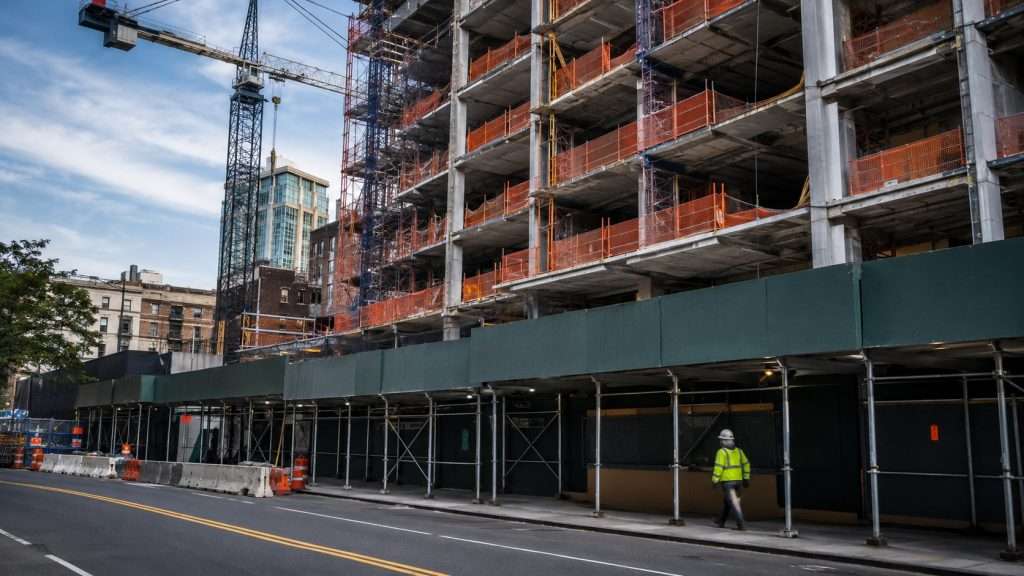
What happens if you’re injured in a New York construction accident, and who’s actually liable? Unlike a typical workplace injury, construction accidents in New York are shaped by a set of state labor laws that go well beyond ordinary negligence rules, plus a separate layer of federal safety standards. Knowing which ones apply often determines who can be held responsible.
New York’s “Scaffold Law” — Labor Law 240
Labor Law Section 240 requires contractors, owners, and their agents to provide proper protection, scaffolding, ladders, hoists, and similar devices, for workers doing elevation-related work such as erecting, demolishing, repairing, or painting a building or structure. Courts have long treated this as close to an absolute liability standard for gravity-related injuries, such as a fall from height or being struck by a falling object, when the required protection wasn’t provided.
Falls inside a store, building lobby, or private property follow a related but separate premises liability standard, where the owner, tenant, or management company in control of the space can be the responsible party.
Labor Law 241 — Specific Site Safety Requirements
Labor Law Section 241 works alongside the Scaffold Law but covers a broader range of construction, excavation, and demolition hazards beyond falls, things like unguarded floor openings, unsafe shoring, and asbestos surveys before demolition work begins. Owners and contractors are required to comply with safety rules the Commissioner of Labor is authorized to establish under this section.
Labor Law 200 — The General Duty Standard
Labor Law Section 200 is New York’s general duty clause, requiring that workplaces be constructed, equipped, and operated to provide reasonable and adequate protection to everyone lawfully present. Unlike the more specific 240 and 241, this section applies broadly and typically requires showing that the party in control of the site had some level of supervisory authority over the way the work was performed.
Federal Safety Standards Still Apply Too
Alongside New York’s own labor laws, federal OSHA fall protection standards require protection whenever construction work is performed six feet or more above a lower level, through guardrails, safety nets, or personal fall arrest systems. A violation of an OSHA standard doesn’t automatically create a lawsuit on its own, but it’s frequently used as evidence of what a reasonably safe job site should have looked like.
The Kinds of Accidents These Laws Cover
The categories that come up most often on New York job sites include falls from scaffolds, ladders, or roofs, being struck by falling tools or materials, scaffold or shoring collapses, trench and excavation cave-ins, and electrocution from unguarded wiring or equipment. Each of these tends to map fairly directly onto one of the Labor Law sections above, which is part of why identifying exactly what happened, and what safety measures were or weren’t in place, matters so much early on.
Photographs of the site immediately after the accident, the specific equipment involved, and any safety devices that were or weren’t in place are often just as important here as they are in any other kind of injury claim, since job sites get cleaned up and rearranged quickly once work resumes.
Workers’ Compensation and Third-Party Claims
Most injured construction workers are covered by their employer’s workers’ compensation insurance, which pays medical costs and a portion of lost wages regardless of fault, but generally bars a lawsuit against that same direct employer. That’s a large part of why Labor Law claims against property owners, general contractors, or other subcontractors, parties other than the injured worker’s own employer, become the primary path to full compensation, including damages workers’ comp doesn’t cover like pain and suffering.
Who Can Actually Be Held Liable
Property owners, general contractors, and their agents are the parties most often named under Labor Law 240 and 241, and courts have applied these protections broadly to cover subcontractors’ employees, not just a single direct employer. There’s a notable exception: owners of one- and two-family homes who contract for work but don’t direct or control it are generally exempt from liability under both sections.
Why These Cases Get Complicated
Construction sites often involve multiple contractors and subcontractors working at once, which means more than one party can potentially be liable for the same accident. Workers’ compensation typically limits an injured worker’s ability to sue their own direct employer, which is part of why claims against property owners, general contractors, or other subcontractors under the Labor Law sections above become so central to these cases. Comparative fault arguments, over safety gear, training, or a worker’s own actions, also come up often and can affect how a claim is valued.
Can a Worker’s Own Actions Defeat a Scaffold Law Claim?
Defendants sometimes argue a worker was the “sole proximate cause” of their own injury, for example by ignoring an available safety device or misusing equipment against instructions. New York courts have recognized this as a potential defense to a Labor Law 240 claim in limited circumstances, but it generally requires showing that adequate safety devices were actually provided and readily available, and that the worker chose not to use them for no good reason. Simply arguing a worker was careless is usually not enough on its own to defeat a claim under the statute.
Contact Held & Hines LLP
If you were injured on a construction site in New York, Held & Hines LLP can review the facts under our Construction Accidents and Personal Injury practice areas and help you understand your options. Contact the firm for a consultation.
FAQ Section
Q: What is New York’s Scaffold Law?
A: Labor Law Section 240 requires contractors, owners, and their agents to provide proper protective devices for elevation-related construction work, and has been applied by courts as close to an absolute liability standard for gravity-related injuries.
Q: What is “notice” and why does it matter in a slip-and-fall case?
A: Often, yes. Workers’ compensation generally limits claims against a direct employer, but Labor Law 240 and 241 allow claims against property owners, general contractors, and their agents.
Q: Can a construction worker sue someone other than their employer?
A: In limited situations, particularly involving certain owner-occupied small residential properties or defects the City itself caused, the City can still bear responsibility instead of the private property owner.
Q: What safety standards must a New York construction site follow?
A: Sites must comply with New York Labor Law 200, 240, and 241, as well as federal OSHA construction standards, including fall protection requirements at heights of six feet or more.
Q: Who can be held responsible for a construction site injury in New York?
A: Typically the property owner, general contractor, and their agents, and in some cases other subcontractors, depending on who controlled the specific work or condition that caused the injury.
This article is for general informational purposes only and does not constitute legal advice. Speaking with an attorney can help you understand how New York law may apply to your specific situation.