
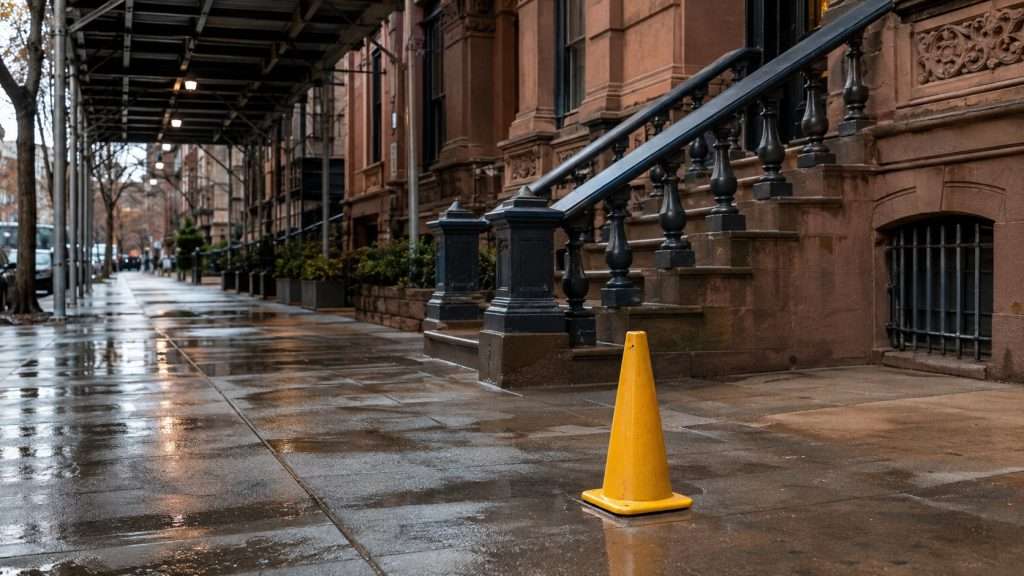
What evidence do you need after a slip-and-fall accident in New York? More than most people expect. Unlike a car accident, where fault is often obvious from the collision itself, a fall case usually turns on whether someone else knew, or should have known, about a hazardous condition and failed to fix it. Without evidence of that knowledge, even a genuinely dangerous condition may not be enough to win a claim.
Who’s Responsible for the Ground You Fell On?
In New York City, sidewalk liability shifted from the City itself to the property owners whose buildings sit next to the sidewalk. Property owners are generally required to install, repair, and maintain the sidewalk in front of their property, including the corner intersection quadrant for buildings on a corner lot, and can be held liable for injuries caused by a failure to keep it in a reasonably safe condition, as described on the NYC Department of Transportation’s sidewalks page. There’s a notable exception for owner-occupied one-, two-, or three-family homes used solely as a residence, where the City may still bear responsibility.
Falls inside a store, building lobby, or private property follow a related but separate premises liability standard, where the owner, tenant, or management company in control of the space can be the responsible party.
Why “Notice” Is the Central Legal Question
Most slip-and-fall cases are decided on one question: did the property owner have notice of the dangerous condition? That can be actual notice, meaning someone already complained about it or the owner created the hazard directly, or constructive notice, meaning the condition existed long enough, and was visible enough, that a reasonable inspection should have caught it. A puddle that formed thirty seconds before someone stepped in it is a very different case from a crack that had been growing for months.
The Evidence That Actually Moves the Needle
A handful of things make or break these cases.
- Any prior complaints, repair records, or 311 reports showing the condition existed before the fall.
- Photos and video of the exact condition, taken as close to the moment of the fall as possible, including wide shots for context and close-ups of the hazard itself.
- Surveillance footage from the property, which many businesses only retain for a short window before it’s overwritten, making a prompt preservation request important.
- An incident report filed with the property owner, store manager, or building staff at the time of the fall.
- Witness names and contact information, since memories fade and people are hard to track down later.
Falls Inside Stores and Buildings Follow Similar Rules
A fall inside a supermarket, office lobby, or apartment building isn’t governed by the sidewalk-specific rules described above, but the underlying question is nearly identical: did the party in control of that space, whether an owner, tenant, or management company, have notice of the hazard and a reasonable opportunity to fix it? Spill logs, cleaning schedules, and maintenance records often become just as important as photos in these cases, since they show whether a business had a system for catching hazards before someone got hurt.
What If You Were Partly at Fault for the Fall?
New York applies a comparative fault rule, meaning a person who was partly careless, distracted while walking, ignoring a visible warning cone, for example, can still recover compensation, just reduced by their own percentage of fault. Property owners and their insurers often raise this argument, so evidence that documents the condition itself, not just the injury, helps counter claims that the fall was purely the injured person’s own doing.
Common Mistakes That Weaken These Claims
Waiting days or weeks to document the scene lets a hazard get fixed or a snow pile melt before anyone can prove what it actually looked like. Assuming the City is automatically responsible for every sidewalk defect is another frequent mistake, given how far sidewalk liability has shifted to private owners. And not identifying the exact property owner, as opposed to a tenant or management company, can send a claim to the wrong party entirely.
What to Do in the First 48 Hours
Photograph the condition from multiple angles, get contact information for anyone who saw the fall, report the incident in writing if there’s a manager or building staff present, and seek medical attention even if the injury seems minor at first. The same three-year filing deadline that applies to most New York personal injury claims applies here too, but the evidence that supports the claim has a much shorter shelf life than the deadline itself.If a written notice or preservation request needs to go to a business or property manager about surveillance footage, sending it sooner rather than later matters. Many commercial security systems overwrite footage automatically after a set number of days, sometimes less than a week, so a delay of even a few days can mean the difference between having video evidence and having none at all.
Contact Held & Hines LLP
If you were injured in a fall on a sidewalk, in a store, or on someone else’s property in New York, Held & Hines LLP can review the facts under our Premise Liability and Slip & Fall Accidents practice areas and help you understand your options. Contact the firm for a consultation.
FAQ Section
Q: Who is responsible for a slip-and-fall on a New York City sidewalk?
A: Generally the property owner whose building abuts the sidewalk, under NYC’s sidewalk liability rules, with an exception for certain owner-occupied one-, two-, or three-family homes.
Q: What is “notice” and why does it matter in a slip-and-fall case?
A: Notice means the property owner knew, or reasonably should have known, about the hazardous condition. Most slip-and-fall cases are won or lost on whether this can be proven.
Q: Should I take photos immediately after a fall?
A: In limited situations, particularly involving certain owner-occupied small residential properties or defects the City itself caused, the City can still bear responsibility instead of the private property owner.
Q: Is the city ever responsible for a sidewalk accident in New York?
A: Yes. Inconsistent or interrupted treatment can be used to argue an injury resolved or wasn’t as serious as claimed, even if that isn’t what actually happened.
Q: How long do I have to file a slip-and-fall claim in New York?
A: Generally three years from the date of the fall under CPLR 214, the same deadline that applies to most New York personal injury claims.
This article is for general informational purposes only and does not constitute legal advice. Speaking with an attorney can help you understand how New York law may apply to your specific situation.